


Slide Image #1
Slide Image #2
Slide Image #3
Slide Image #4
Slide Image #5
mlsrealtor

Blog

The One Thing Every Homeowner Needs To Know About a Recession

The One Thing Every Homeowner Needs To Know About a Recession
The One Thing Every Homeowner Needs To Know About a Recession | MyKCM

A recession does not equal a housing crisis. That’s the one thing that every homeowner today needs to know. Everywhere you look, experts are warning we could be heading toward a recession, and if true, an economic slowdown doesn’t mean homes will lose value.

The National Bureau of Economic Research (NBER) defines a recession this way:

“A recession is a significant decline in economic activity spread across the economy, normally visible in production, employment, and other indicators. A recession begins when the economy reaches a peak of economic activity and ends when the economy reaches its trough. Between trough and peak, the economy is in an expansion.”

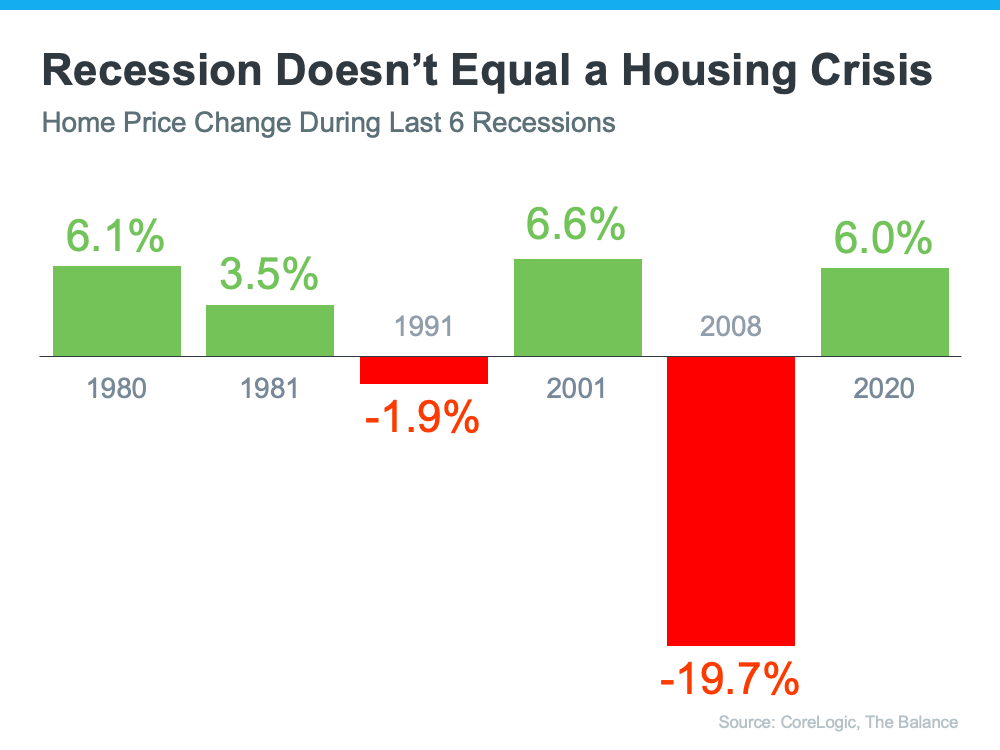
To help show that home prices don’t fall every time there’s a recession, take a look at the historical data. There have been six recessions in this country over the past four decades. As the graph below shows, looking at the recessions going all the way back to the 1980s, home prices appreciated four times and depreciated only two times. So, historically, there’s proof that when the economy slows down, it doesn’t mean home values will fall or depreciate.
The One Thing Every Homeowner Needs To Know About a Recession | MyKCM

The first occasion on the graph when home values depreciated was in the early 1990s when home prices dropped by less than 2%. It happened again during the housing crisis in 2008 when home values declined by almost 20%. Most people vividly remember the housing crisis in 2008 and think if we were to fall into a recession that we’d repeat what happened then. But this housing market isn’t a bubble that’s about to burst. The fundamentals are very different today than they were in 2008. So, we shouldn’t assume we’re heading down the same path.

Bottom Line

We’re not in a recession in this country, but if one is coming, it doesn’t mean homes will lose value. History proves a recession doesn’t equal a housing crisis.


Source: https://www.simplifyingthemarket.com/en/2022/05/19/the-one-thing-every-homeowner-needs-to-know-about-a-recession/?a=5256-fd674d1a840c47baa4da566e9ff662ab

If You’re a Homeowner, You Have Incredible Leverage When You Sell Today

If You’re a Homeowner, You Have Incredible Leverage When You Sell Today

If You’re a Homeowner, You Have Incredible Leverage When You Sell Today | MyKCM

In today’s housing market, homeowners have a great opportunity to sell their house and receive the best terms for their personal situation. That’s because there’s a limited number of homes for sale, which is creating competition among buyers. Right now, homebuyers want three things:

These buyer needs give you an amazing advantage – also known as leverage – when you sell.

What Does This Mean for Sellers Today?

You might already realize this enables you to sell at a good price, but you’re also in a great position to get the best terms to suit your needs.

According to the latest Realtors Confidence Index from the National Association of Realtors (NAR), the average home sold is receiving 4.8 offers. That’s why there’s a good chance you’ll get offers from multiple buyers who are willing to compete for your house. When you do, you should look closely at the terms of each offer to find out which one has the best options for you.

And if you have questions at any point in the process, remember your trusted real estate advisor can help. They’re experts who understand the fine print, know how to compare the terms of various offers, and will help you select the best one for your situation.

Bottom Line

If you’re thinking of selling your home, know buyer demand in today’s market gives you a great opportunity to get the best terms and price when you sell your house. Let’s connect today to discuss how much leverage you have as a seller in today’s market.

Source: https://www.simplifyingthemarket.com/en/2022/05/16/if-youre-a-homeowner-you-have-incredible-leverage-when-you-sell-today/?a=5256-fd674d1a840c47baa4da566e9ff662ab

Are There More Homes Coming to the Market?

Are There More Homes Coming to the Market?

Are There More Homes Coming to the Market? | MyKCM

According to a recent survey from the National Association of Realtors (NAR), one of the top challenges buyers face in today’s housing market is finding a home that meets their needs. That’s largely because the inventory of homes for sale is so low today.

If you’re looking to buy a home, you may have noticed this yourself. But there is good news. Recent data shows more sellers are listing their houses this season, which may give you more options for your home search.

Early Signs Inventory May Be Growing

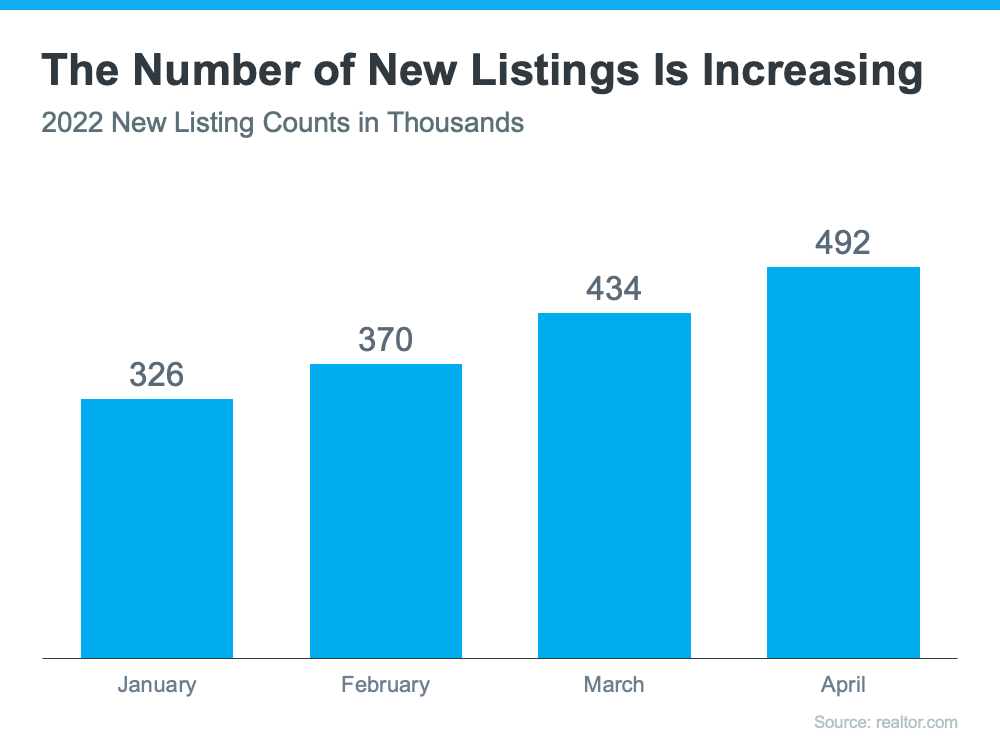
The latest data from realtor.com shows the number of listings coming onto the market, known in the industry as “new listings,” has increased since the start of the year (see graph below):

Are There More Homes Coming to the Market? | MyKCM

This indicates more sellers are listing their homes for sale each month this year. And according to realtor.com, this growth is expected to continue. Their research finds the majority of potential sellers plan to list their homes over the next six months. Realtor.com says:

“. . .markets may see a noticeable bump in the number of homes for sale as we move through spring and into summer. A majority of homeowners planning to sell this year indicated that they aim to list in the next six months, with almost 10% having already placed their properties on the market.”

Homes Are Still Selling Quickly

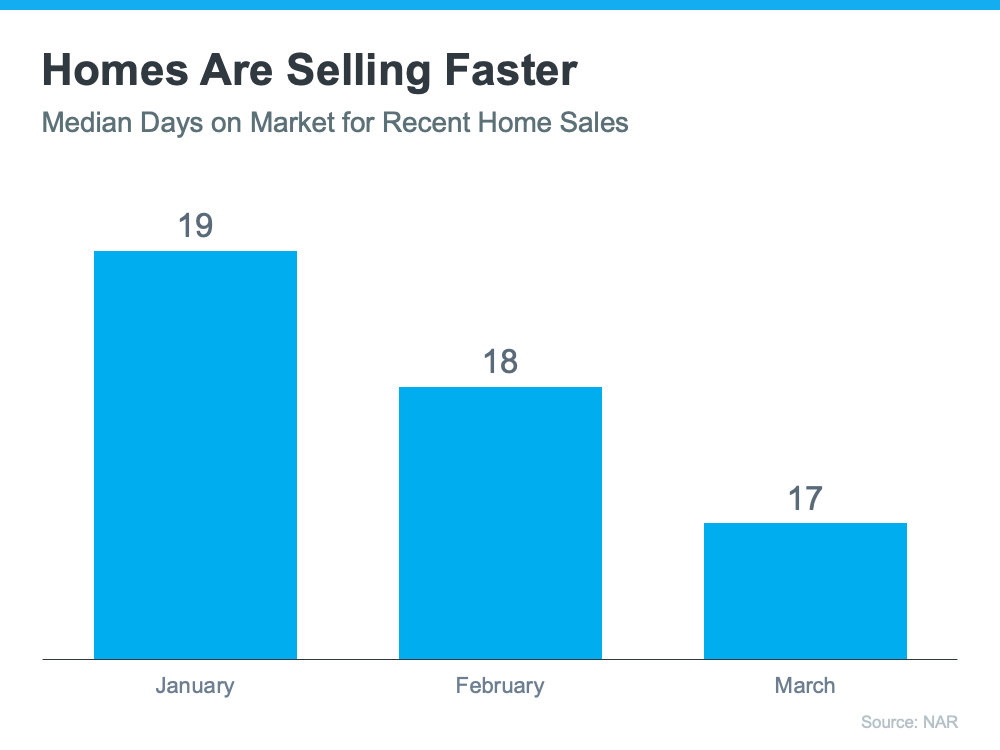
But while new listings are increasing, it’s important to know they’re also selling quickly. The latest Realtors Confidence Index from NAR shows the median days on market for recently sold homes since the beginning of the year (see chart below). The time on market has decreased month-over-month. That means homes are selling even faster than they did the previous month.

Are There More Homes Coming to the Market? | MyKCM

What That Means for You

While a low-inventory market is difficult to navigate as a buyer, there is hope. The growing number of new listings and the expectation more sellers will list their homes in the coming months is great news if you’ve had a hard time finding a home that fits your needs. Just remember, those new listings are going fast. That means you’ll want to keep your foot on the gas and be ready to act if you find a home you love this season.

Your agent can help you stay on top of the latest listings in your area so you can find the home that’s right for you and submit your strongest offer as quickly as possible.

Bottom Line

If you’ve been having a hard time finding your dream home, stick with your search. More options are coming to market and your ideal home could be one of them. Let’s connect so you can stay up to date on the latest listings in our market, so you can be ready to move fast when you find the one that’s right for you.

Source: https://www.simplifyingthemarket.com/en/2022/05/11/are-there-more-homes-coming-to-the-market/?a=5256-fd674d1a840c47baa4da566e9ff662ab

Three Tips for First-Time Homebuyers

Three Tips for First-Time Homebuyers

Three Tips for First-Time Homebuyers | MyKCM

Buying your first home is a major decision and an exciting milestone. Even though it can feel daunting at times, it has the power to change your life for the better. If you’re looking to purchase your first home, you may be wondering what’s happening in the housing market today, how much you need to save, and where to start.

Here are three things that can help give you the information you need to confidently pursue your dream of homeownership.

1. Consider All Options When the Number of Homes for Sale Is Low

Today, there are far more buyers in the market than there are homes available for sale. When that happens, it’s a good idea to do what you can to increase your pool of options. That could mean expanding your search to include additional housing types. For first-time buyers, considering condominiums (condos) and townhomes can be an excellent way to increase your choices. According to Bankrate:

“Townhomes often cost less than single-family homes of a similar size in the same location.”

In another article, Bankrate also says:

“Buying a condo can be a great way to dive into homeownership without worrying about the upkeep that comes with single-family homes and townhouses.”

Condos and townhomes are both great entryways into homeownership. When you buy either one, you can start building equity which increases your net worth and can fuel a future move.

2. Know Your Down Payment Could Be More Within Reach Than You Think

Saving for a down payment can feel like one of the biggest obstacles for homebuyers, but that doesn’t have to be the case. As the National Association of Realtors (NAR) says:

“One of the biggest misconceptions among housing consumers is what the typical down payment is and what amount is needed to enter homeownership.”

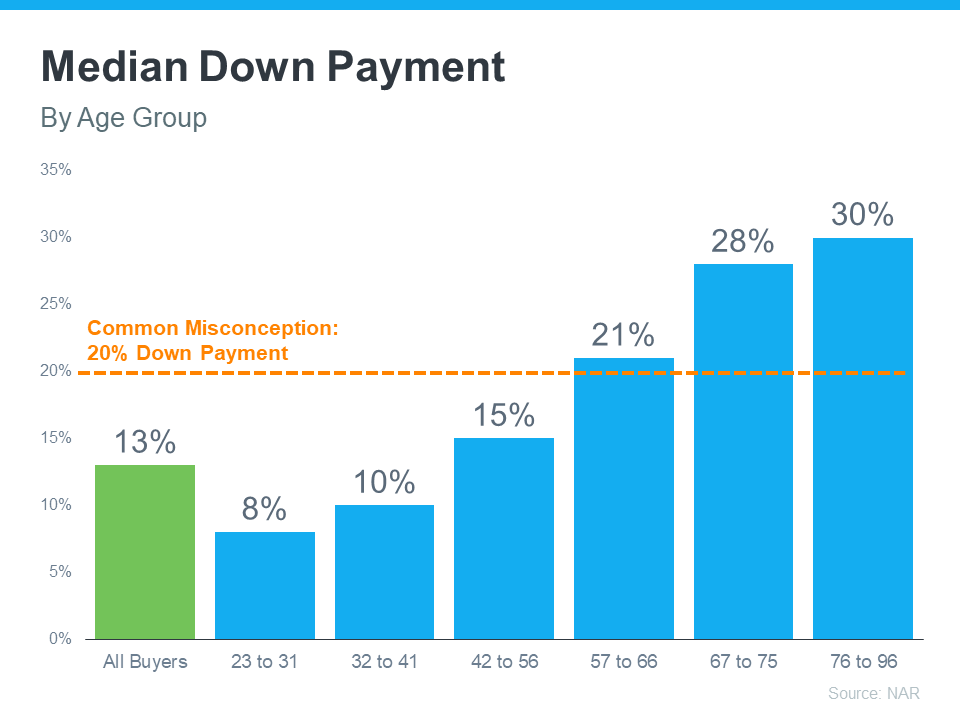
Data from NAR shows the median down payment hasn’t been over 20% since 2005. The graph below breaks down the median down payment by age group for recent homebuyers according to the 2022 Home Buyers and Sellers Generational Trends Report from NAR (see graph below):

Three Tips for First-Time Homebuyers | MyKCM

Based on the data above, the median down payment for all homebuyers is only 13%. That’s well below the common misconception of 20%, and it’s even lower for younger buyers. This could mean you may not need to save as much for a down payment as you initially thought.

There are also down payment assistance programs available for many buyers. Not to mention, some loan options require as little as 3.5% (or even 0%) down for buyers who qualify. While there are advantages to putting 20% down, especially in today’s competitive market, know that you have options.  To get more information on how much you may need to save and the help that’s available, talk with a professional.

3. Work with a Trusted Real Estate Advisor Throughout the Process

Finally, no matter where you’re at in your homeownership journey, the best way to make sure you’re set up for success is to work with a real estate professional.

If you’re just starting out, they can help you with the initial steps, like educating you on the process and connecting you with a trusted lender to get pre-approved. Once you’re ready to begin your search, a real estate professional can help you understand your local market and search for available homes. And when it’s time to make an offer, they’ll be an expert advisor and negotiator to help your offer stand out above the rest.

Bottom Line

Knowledge is key to succeeding on your homebuying journey. Knowing market trends, what you need for a down payment, and what options you have as a buyer today can give you the confidence you need to buy a home. Let’s connect so you have an expert on your side who can help you navigate the homebuying process.

Source: https://www.mykcm.com/2022/05/05/three-tips-for-first-time-homebuyers/

Homeownership and Inflation

How Homeownership Can Help Shield You from Inflation

How Homeownership Can Help Shield You from Inflation | MyKCM

If you’re following along with the news today, you’ve likely heard about rising inflation. You’re also likely feeling the impact in your day-to-day life as prices go up for gas, groceries, and more. These rising consumer costs can put a pinch on your wallet and make you re-evaluate any big purchases you have planned to ensure they’re still worthwhile.

If you’ve been thinking about purchasing a home this year, you’re probably wondering if you should continue down that path or if it makes more sense to wait. While the answer depends on your situation, here’s how homeownership can help you combat the rising costs that come with inflation.

Homeownership Offers Stability and Security

Investopedia explains that during a period of high inflation, prices rise across the board. That’s true for things like food, entertainment, and other goods and services, even housing. Both rental prices and home prices are on the rise. So, as a buyer, how can you protect yourself from increasing costs? The answer lies in homeownership.

Buying a home allows you to stabilize what’s typically your biggest monthly expense: your housing cost. If you get a fixed-rate mortgage on your home, you lock in your monthly payment for the duration of your loan, often 15 to 30 years. James Royal, Senior Wealth Management Reporter at Bankrate, says:

“A fixed-rate mortgage allows you to maintain the biggest portion of housing expenses at the same payment. Sure, property taxes will rise and other expenses may creep up, but your monthly housing payment remains the same.”

So even if other prices rise, your housing payment will be a reliable amount that can help keep your budget in check. If you rent, you don’t have that same benefit, and you won’t be protected from rising housing costs.

Use Home Price Appreciation to Your Benefit

While it’s true rising mortgage rates and home prices mean buying a house today costs more than it did a year ago, you still have an opportunity to set yourself up for a long-term win. Buying now lets you lock in at today’s rates and prices before both climb higher.

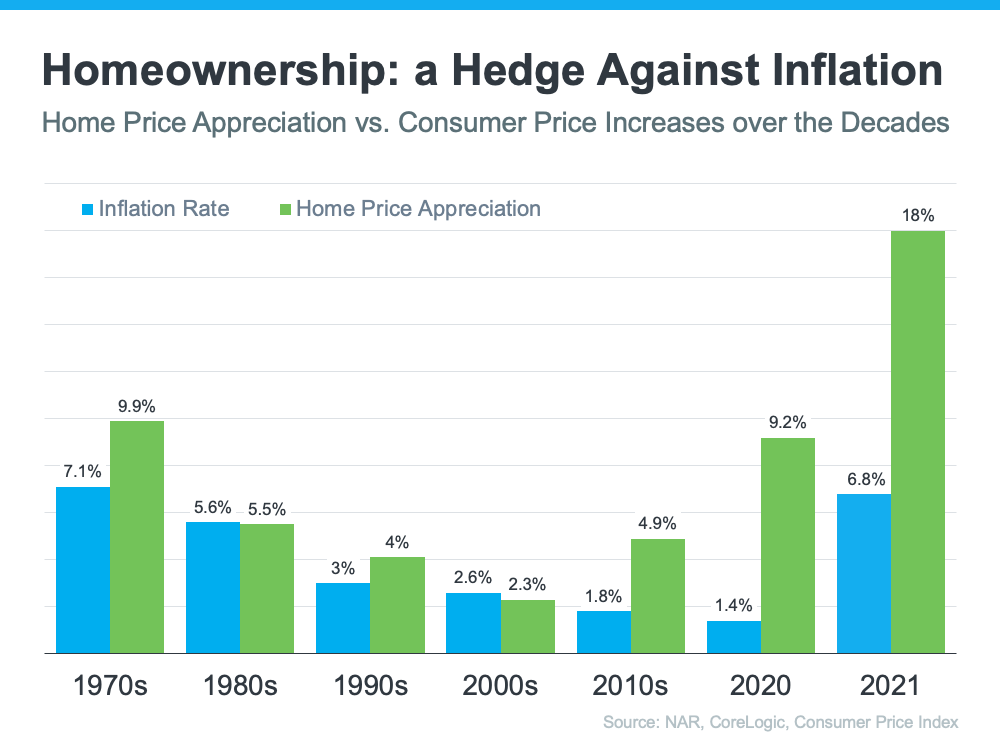
In inflationary times, it’s especially important to invest your money in an asset that traditionally holds or grows in value. The graph below shows how home price appreciation outperformed inflation in most decades going all the way back to the seventies – making homeownership a historically strong hedge against inflation (see graph below):

How Homeownership Can Help Shield You from Inflation | MyKCM

So, what does that mean for you? Today, experts say home prices will only go up from here thanks to the ongoing imbalance in supply and demand. Once you buy a house, any home price appreciation that does occur will be good for your equity and your net worth. And since homes are typically assets that grow in value (even in inflationary times), you have peace of mind that history shows your investment is a strong one.

Bottom Line

If you’re ready to buy a home, it may make sense to move forward with your plans despite rising inflation. If you want expert advice on your specific situation and how to time your purchase, let’s connect.

Source: https://www.mykcm.com/2022/04/26/how-homeownership-can-help-shield-you-from-inflation/

The Future of Home Price Appreciation and What It Means for You

The Future of Home Price Appreciation and What It Means for You

The Future of Home Price Appreciation and What It Means for You | MyKCM

Many consumers are wondering what will happen with home values over the next few years. Some are concerned that the recent run-up in home prices will lead to a situation similar to the housing crash 15 years ago.

However, experts say the market is totally different today. For example, Odeta Kushi, Deputy Chief Economist at First American, tweeted just last week on this issue:

“. . . We do need price appreciation to slow today (it’s not sustainable over the long run) but high price growth today is supported by fundamentals- short supply, lower rates & demographic demand. And we are in a much different & safer space: better credit quality, low DTI [Debt-To-Income] & tons of equity. Hence, a crash in prices is very unlikely.”

Price appreciation will slow from the double-digit levels the market has seen over the last two years. However, experts believe home values will not depreciate (where a home would lose value).

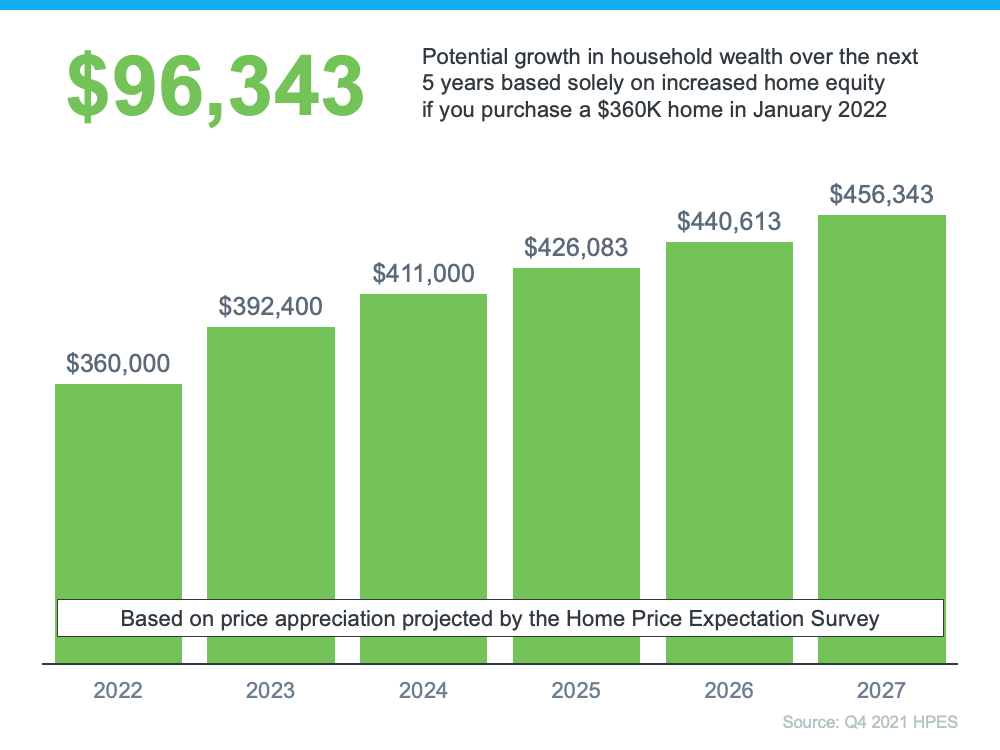
To this point, Pulsenomics just released the latest Home Price Expectation Survey – a survey of a national panel of over 100 economists, real estate experts, and investment and market strategists. It forecasts home prices will continue appreciating over the next five years. Below are the expected year-over-year rates of home price appreciation based on the average of all 100+ projections:

  • 2022: 9%
  • 2023: 4.74%
  • 2024: 3.67%
  • 2025: 3.41%
  • 2026: 3.57%

Those responding to the survey believe home price appreciation will still be relatively high this year (though half of what it was last year), and then return to more normal levels over the next four years.

What Does This Mean for You as a Buyer?

With a limited supply of homes available for sale and both prices and mortgage rates increasing, it can be a challenging market to navigate as a buyer. But buying a home sooner rather than later does have its benefits. If you wait to buy, you’ll pay more in the future. However, if you buy now, you’ll actually be in the position to make future price increases work for you. Once you buy, those rising home prices will help you build your home’s value, and by extension, your own household wealth through home equity.

As an example, let’s assume you purchased a $360,000 home in January of this year (the median price according to the National Association of Realtors rounded up to the nearest $10K). If you factor in the forecast for appreciation from the Home Price Expectation Survey, you could accumulate over $96,000 in household wealth over the next five years (see graph below):

The Future of Home Price Appreciation and What It Means for You | MyKCM

Bottom Line

If you’re trying to decide whether to buy now or wait, the key is knowing what’s expected to happen with home prices. Experts say prices will continue to climb in the years ahead, just at a slower pace. So, if you’re ready to buy, doing so now may be your best bet for your wallet. It’ll also give you the chance to use the future home price appreciation to build your own net worth through rising equity. If you want to get started, let’s connect today.

Source: Keeping Current Matters https://www.mykcm.com/2022/04/07/the-future-of-home-price-appreciation-and-what-it-means-for-you/

2021 Real Estate Mid Year Update

2021 Real Estate Mid Year Update

It’s no secret that the real estate market has been on fire in 2021. Though 2020 was a challenge it certainly did not prepare us for the frenzy that 2021 has brought and while the market is hot Nationwide, South Florida is even hotter! The top real estate related questions being asked on Google are “Are we in a Bubble?” and “Why is the real estate market so hot?”. To answer these questions our team has put together a market update for you.

As always, we look forward to hearing from you with any questions or comments. Do you want any specifics about your neighborhood or the value of your home? Call us, we’re happy to assist you and yours with all your real estate needs.

What If I Need to Sell My Home Now? What Can I Do?

What If I Need to Sell My Home Now? What Can I Do?

What If I Need to Sell My Home Now? What Can I Do? | MyKCM

Every day that passes, people have a need to buy and sell homes. That doesn’t stop during the current pandemic. If you’ve had a major life change recently, whether with your job or your family situation, you may be in a position where you need to sell your home – and fast. While you probably feel like timing with the current pandemic isn’t on your side, making a move is still possible. Rest assured, with technology at your side and fewer sellers on the market in most areas, you can list your house and make it happen safely and effectively, especially when following the current COVID-19 guidelines set forth by the National Association of Realtors (NAR) and the Centers for Disease Control and Prevention (CDC).

You may have a new baby, a new employment situation, a parent who moved in with you, you just built a home that’s finally ready to move into, or some other major part of your life that has changed in recent weeks. Buyers have those needs too, so rest assured that someone is likely looking for a home just like yours.

According to the NAR Flash Survey: Economic Pulse taken April 5 – 6, real estate agents indicate, not surprisingly, that there’s a noticeable decline in current homebuyer interest. That said, 10% of agents said in the same survey that they saw no change or even an increase in buyer activity. So, while buyer interest is low compared to normal spring markets, there are still buyers in the market. Don’t forget, you only need one buyer – the right one for your home.

Here’s the other thing – people are spending a lot of time on the Internet right now, given the stay-at-home orders implemented across the country. Buyers are actively looking at homes for sale online. Some of them are reaching out to real estate professionals for virtual tours and getting ready to make offers too. Homes are being sold in many markets.

There Is Less Competition Right Now

The same survey indicates that 56% of NAR members said sellers are removing their homes from the market right now. This can definitely work in your favor. If other sellers are removing their listings, your home has a better chance of rising to the top of a buyer’s search list and being seen. Keep in mind, listings will pick up again soon, as 57% of the respondents note that sellers are only planning to delay the process by a couple of months. If you need to sell right now, don’t wait for the competition to get back into the market again.

This year, delayed listings from the typically busy spring season will push into the summer months, so more competition will be coming to the market as the pandemic passes. Getting ahead of that wave now might be your biggest opportunity.

Your Trusted Real Estate Advisor Can Help

Real estate agents are working hard every single day under untraditional circumstances, utilizing technology to help both buyers and sellers who need to continue with their plans. We’re using virtual tours to show homes currently on the market, staying connected with the buyers and sellers through video chats, and leveraging resources to complete transactions electronically. We’re making sure the families we support remain safe and can keep their real estate needs on track, especially as life is changing so rapidly.

Bottom Line

Homes are still being bought and sold in the midst of this pandemic. If you need to sell your house and would like to know the current status in our local market, let’s work together to create a safe and effective plan that works for you and your family.


Source: https://www.keepingcurrentmatters.com/

The information contained, and the opinions expressed, in this article are not intended to be construed as investment advice. Keeping Current Matters, Inc. does not guarantee or warrant the accuracy or completeness of the information or opinions contained herein. Nothing herein should be construed as investment advice. You should always conduct your own research and due diligence and obtain professional advice before making any investment decision. Keeping Current Matters, Inc. will not be liable for any loss or damage caused by your reliance on the information or opinions contained herein.

The Covid-19 Pandemic And The Real Estate Market

5 Simple Graphs Proving This Is NOT Like the Last Time

5 Simple Graphs Proving This Is NOT Like the Last Time | MyKCM

With all of the volatility in the stock market and uncertainty about the Coronavirus (COVID-19), some are concerned we may be headed for another housing crash like the one we experienced from 2006-2008. The feeling is understandable. Ali Wolf, Director of Economic Research at the real estate consulting firm Meyers Research, addressed this point in a recent interview:

“With people having PTSD from the last time, they’re still afraid of buying at the wrong time.”

There are many reasons, however, indicating this real estate market is nothing like 2008. Here are five visuals to show the dramatic differences.

1. Mortgage standards are nothing like they were back then.

During the housing bubble, it was difficult NOT to get a mortgage. Today, it is tough to qualify. The Mortgage Bankers’ Association releases a Mortgage Credit Availability Index which is “a summary measure which indicates the availability of mortgage credit at a point in time.” The higher the index, the easier it is to get a mortgage. As shown below, during the housing bubble, the index skyrocketed. Currently, the index shows how getting a mortgage is even more difficult than it was before the bubble.5 Simple Graphs Proving This Is NOT Like the Last Time | MyKCM

2. Prices are not soaring out of control.

Below is a graph showing annual house appreciation over the past six years, compared to the six years leading up to the height of the housing bubble. Though price appreciation has been quite strong recently, it is nowhere near the rise in prices that preceded the crash.5 Simple Graphs Proving This Is NOT Like the Last Time | MyKCMThere’s a stark difference between these two periods of time. Normal appreciation is 3.6%, so while current appreciation is higher than the historic norm, it’s certainly not accelerating beyond control as it did in the early 2000s.

3. We don’t have a surplus of homes on the market. We have a shortage.

The months’ supply of inventory needed to sustain a normal real estate market is approximately six months. Anything more than that is an overabundance and will causes prices to depreciate. Anything less than that is a shortage and will lead to continued appreciation. As the next graph shows, there were too many homes for sale in 2007, and that caused prices to tumble. Today, there’s a shortage of inventory which is causing an acceleration in home values.5 Simple Graphs Proving This Is NOT Like the Last Time | MyKCM

4. Houses became too expensive to buy.

The affordability formula has three components: the price of the home, the wages earned by the purchaser, and the mortgage rate available at the time. Fourteen years ago, prices were high, wages were low, and mortgage rates were over 6%. Today, prices are still high. Wages, however, have increased and the mortgage rate is about 3.5%. That means the average family pays less of their monthly income toward their mortgage payment than they did back then. Here’s a graph showing that difference:5 Simple Graphs Proving This Is NOT Like the Last Time | MyKCM

5. People are equity rich, not tapped out.

In the run-up to the housing bubble, homeowners were using their homes as a personal ATM machine. Many immediately withdrew their equity once it built up, and they learned their lesson in the process. Prices have risen nicely over the last few years, leading to over fifty percent of homes in the country having greater than 50% equity. But owners have not been tapping into it like the last time. Here is a table comparing the equity withdrawal over the last three years compared to 2005, 2006, and 2007. Homeowners have cashed out over $500 billion dollars less than before:5 Simple Graphs Proving This Is NOT Like the Last Time | MyKCMDuring the crash, home values began to fall, and sellers found themselves in a negative equity situation (where the amount of the mortgage they owned was greater than the value of their home). Some decided to walk away from their homes, and that led to a rash of distressed property listings (foreclosures and short sales), which sold at huge discounts, thus lowering the value of other homes in the area. That can’t happen today.

Bottom Line

If you’re concerned we’re making the same mistakes that led to the housing crash, take a look at the charts and graphs above to help alleviate your fears.


Source: https://www.keepingcurrentmatters.com/

The information contained, and the opinions expressed, in this article are not intended to be construed as investment advice. Keeping Current Matters, Inc. does not guarantee or warrant the accuracy or completeness of the information or opinions contained herein. Nothing herein should be construed as investment advice. You should always conduct your own research and due diligence and obtain professional advice before making any investment decision. Keeping Current Matters, Inc. will not be liable for any loss or damage caused by your reliance on the information or opinions contained herein.

2019 Housing Market Outlook

Although it’s impossible to predict the future, current trends and statistics create a picture of the market’s health. Read on for where the market is now,  three things to watch for in 2019 and the market outlook.

The National Market as we begin 2019

Home prices are up 4.6 percent and the average home value is $264,800.1   Sales may be down, but prices will continue to rise. This is good news for sellers, but may keep buyers on the sidelines in high-price markets.

Home sales are down 1.5 percent from a year ago.1 Experts say that many buyers are priced out of the market or they’re waiting until more homes within their price range are available.

Homes are selling fast. Homes are on the market for an average of only 29 days, with 52 percent of homes on the market for less than a month.1 Some experts indicate the 2019 market time will be longer as the inventory increases taking up to 6 months to sell.

Inventory is tight. 1 People are staying in their homes longer and housing starts are at an all-time low.2 However, housing permits are up 8.4 percent over last year, which means more inventory to come.3

Competition is high. First-time buyers made up 31 percent of home purchasers.1 For those in the market to buy, get preapproved for a mortgage to stay competitive. If you need a lender, we can refer you to a great one in our network.

Competition is high. First-time buyers made up 31 percent of home purchasers.1 For those in the market to buy, get preapproved for a mortgage to stay competitive. If you need a lender, we can refer you to a great one in our network.

THREE THINGS TO WATCH FOR IN 2019

1.  INTEREST RATES:Experts predict the Federal Reserve will increase interest rates two times in 2019.4 However, increases are expected to be gradual.

2. INFLATION: Inflation is expected to increase slightly in 2019, due in part to a strengthening labor market and tariffs.

3. STRENGTH OF ECONOMY: The economy continues to grow and strengthen, a trend that is expected to endure in 2019.

Will we see a Market Correction?5

Recently, you may have seen news headlines predicting the next recession. The economy has been growing since 2009, the longest stretch in U.S. history.5 Since the economy is cyclical, it’s only natural to wonder when the economy will begin to retract.

Causes of a downturn. Recessions are often caused by unforeseen events or circumstances that shock the market. Sixty-two percent of experts say an overheating economy will lead to the Fed tightening it’s belt.5  Others say a financial meltdown may be caused by an asset bubble, fiscal crisis or international trade disruptions.5

Reasons to be optimistic. Housing isn’t likely to play a large role in the next recession.5 Although affordability remains a concern in many areas of the country, experts say that housing is unlikely to cause another recession.5

Take headlines with a grain of salt. Experts predicted recessions in 2011 and 2016, and neither transpired. It is important to remember that growth doesn’t last, so a downturn would be considered natural. Over the next year, economists predict the Gross Domestic Product (GDP) will continue to grow and unemployment rates will fall further. The risk of recession in the next year is only about 15 percent, and the changes to the tax code effective this year are expected to drive business investment spending.

Sources:

  1. National Association of REALTORS
  2. CNN Money
  3. National Association of Home Builders
  4. HousingWire
  5. Wall Street Journal